
Solar ATAP has brought back something many homeowners and business owners have been waiting for: the ability to export excess solar energy back to the TNB grid. Because of that, one question keeps coming up:
“If export is allowed again, does that mean installing a bigger solar system will help me save more — because I can export more solar energy to the TNB grid?”
That question is reasonable. But under Solar ATAP, the answer is not as straightforward as it used to be. To understand whether Solar ATAP is worth it for your home or business in Malaysia, you need to understand how export works under this scheme — and how that changes the way solar systems should be designed.
What Is Solar ATAP — and How Is It Different from NEM?
Solar ATAP (Solar Accelerated Transition Action Programme) is a solar scheme that allows electricity consumers to:
- Install solar panels on their home or business rooftop
- Use solar energy for their own consumption
- Export excess solar energy generated to the TNB grid
- Receive bill credits (not cash) in return for exports to offset your electricity bills
At a glance, this sounds similar to the old Net Energy Metering (NEM) scheme. The key difference is not whether export is allowed — but how export credits behave.
How are export credits valued?
- For homeowners (domestic): Export credits reduce the energy charge on your TNB bill – the portion based on kilowatt-hours (kWh) consumed.
- For businesses (non-domestic): Export credits are valued using average system marginal price (SMP) – a market-based electricity price, not your retail tariff.
Under Solar ATAP:
- Export credits are settled monthly
- Credits cannot be carried forward
- Any unused credits expire at the end of the month
Under the previous NEM, unused credits could be carried over to future months. That single difference changes everything.

“If I Install a Larger Solar System, Can I Export More and Save More?”
This is where many people get confused. Yes — installing a larger system usually means generating more solar energy. But under Solar ATAP, generating more does not automatically mean saving more. Why? Because the credits you earn from exporting solar energy can only be used to cancel out the electricity you still buy from TNB in that same month. In simple terms:
- You can only offset what you actually imported from TNB.
- Once your bill is already reduced to zero for that month, any additional exported energy no longer reduces your bill or adds value.
This is where system size becomes critical — not because bigger systems don’t generate energy, but because not all generated energy can be used or credited.
System Size Explained
Let’s look at a simple household example:
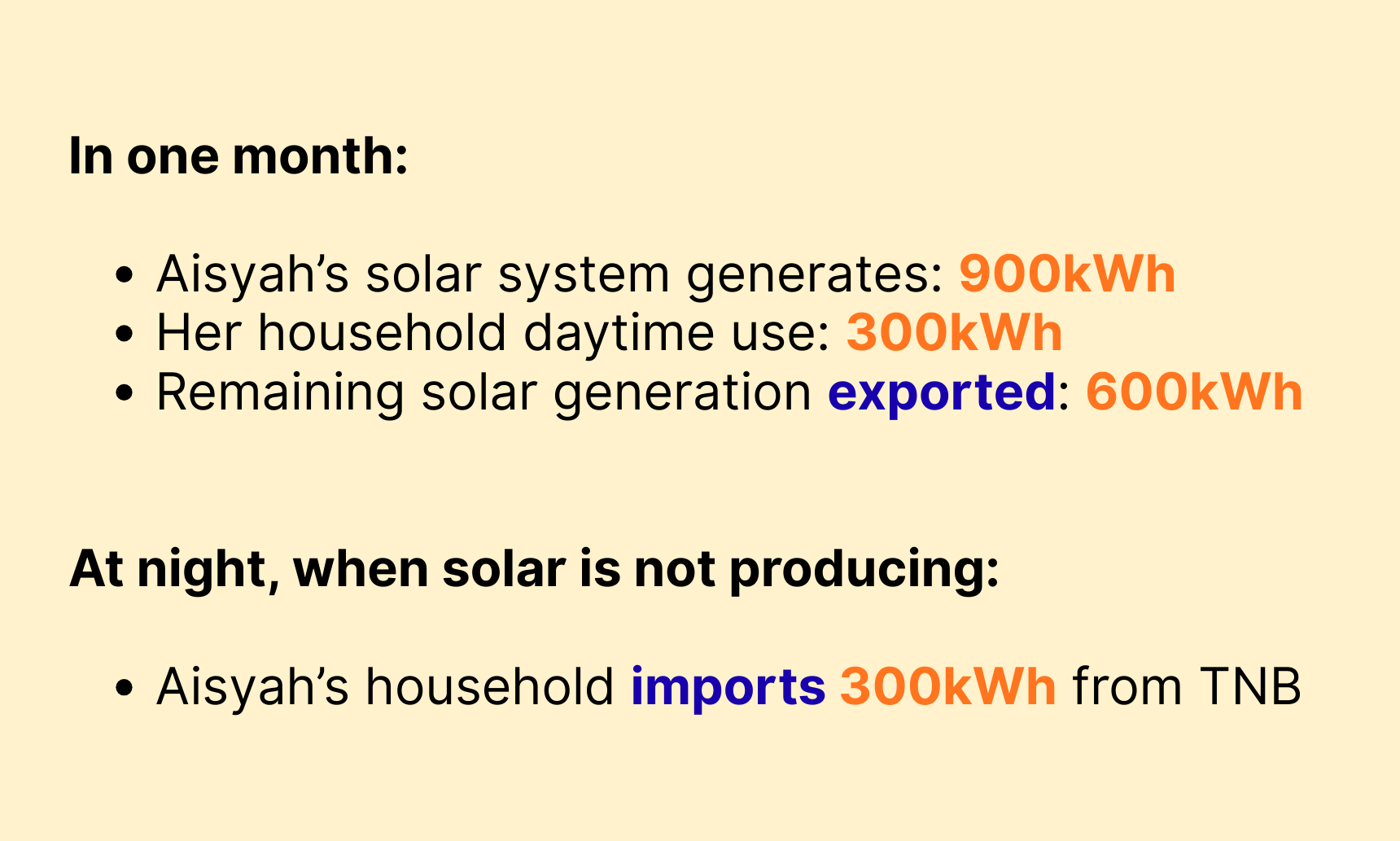
Even though 600kWh was exported, only 300kWh can be used to offset the bill because that is all the electricity imported that month. The remaining 300kWh expires.
Nothing is wrong with the solar system. The energy was generated — but its value couldn’t be fully used. This is why simply installing a larger system does not guarantee higher savings under Solar ATAP.

Even So — Does Solar Still Give Good Savings?
Yes. Solar still saves money. Every unit of electricity you use directly from your solar generation is one less unit you pay TNB for. That saving is immediate and permanent. What Solar ATAP changes is: where those savings come from. Savings are now driven mainly by:
- How much solar energy you use directly
- How closely system size matches real usage
- How little energy goes unused or expires
Solar still pays back — but poorly matched systems take longer and deliver weaker returns.
Under Solar ATAP, What Are Your Options?
Once monthly settlement is understood, Solar ATAP presents a clear choice: What should happen to excess solar energy?
You have two main options:
- Export it for bill credits (with limits) as explained above, or
- Store it in a Battery Energy Storage System (BESS) and use it later.
Each option serves a different purpose.
%20beside%20a%20factory%20for%20a%20factory.png)
What Is BESS (Battery Energy Storage System)?
A battery system (BESS) is best understood as a power bank for your solar system. Instead of exporting excess solar:
- The battery stores the excess solar energy your solar system generates
- It discharges it when solar generation is low
Batteries:
- Reduce your reliance on monthly export credits
- Allow better use of excess solar
- Require higher upfront investment
They don’t make solar generate more — they help capture more of the value it already produces.
Where BESS Helps — Homes vs Businesses
A. Homes
Batteries tend to help when excess solar regularly expires unused. However, not every home in Malaysia needs a battery.
Homes that:
- Use electricity during the day
- Size solar conservatively
- Produce limited excess
- See real value from export credits
can already perform well under Solar ATAP without batteries. Because batteries add cost, the decision should be based on whether the extra value captured justifies the investment.
B. Businesses
For businesses, batteries often create value beyond export:
- Reducing peak demand charges
- Smoothing sudden load spikes
- Improving cost predictability
In many Malaysian commercial setups, batteries are less about export credits — and more about total cost control.

Final Verdict: Is Solar ATAP Good or Bad?
Solar ATAP is neither good nor bad. It is more structured. It rewards:
- Right-sized solar systems
- Predictable usage patterns
- Thoughtful design
Under Solar ATAP, the best system is not the biggest one — it is the one designed around how electricity is actually used in your household or operations.
If You’re an Existing NEM User, Should You Switch from NEM to Solar ATAP?
There is no one-size-fits-all answer. Whether switching from NEM to Solar ATAP makes sense depends on how your existing solar system is performing today — and how your electricity is actually used.
A Key Fact for Residential Users:
- Under NEM, your rebate rate is generally better compared to ATAP.
Businesses and Residential Users:
Staying with NEM may make sense if:
- You regularly carry forward export credits
- Your solar still offsets your bill effectively
Under NEM, unused credits do not expire, so exporting excess energy still retains long-term value.
Switching to Solar ATAP may make sense if:
- You are planning a new solar installation
- Your usage pattern is predictable month to month
- You plan to size your system conservatively around self-consumption
- You are considering adding battery storage
Solar ATAP rewards systems designed around real usage, not maximum export.
When you understand that, you make better decisions — and that is exactly what this scheme is designed to encourage.
If you’d like to understand Solar ATAP,Battery Energy Storage Systems (BESS), or other solar schemes like SELCO — and how they apply to your situation — our energy experts are here to help. As always free consultations available, no strings attached.
Helpful reads:
- Official Solar ATAP Guidelines
- Solar ATAP Guidelines simplified
- SELCO: Everything you need to know.
- SELCO or Solar ATAP: Which suits you better?
- What is BESS (Battery Energy Storage System)?
- Latest TNB Tariff Structure Domestic
- Latest TNB Tariff Structure Non-Domestic
- How we maintain your solar system
*For informational use only. Please talk to our energy experts before proceeding.